Normal Accidents by Charles Perrow - Notes
2026-06-08 – Transcribed notes on Failure Areas, Failure Origins, Operating Experience, and Process Adherence from Charles Perrow's Normal Accidents.
Normal Accidents
📖 View Original Handwritten Notes (English Source)
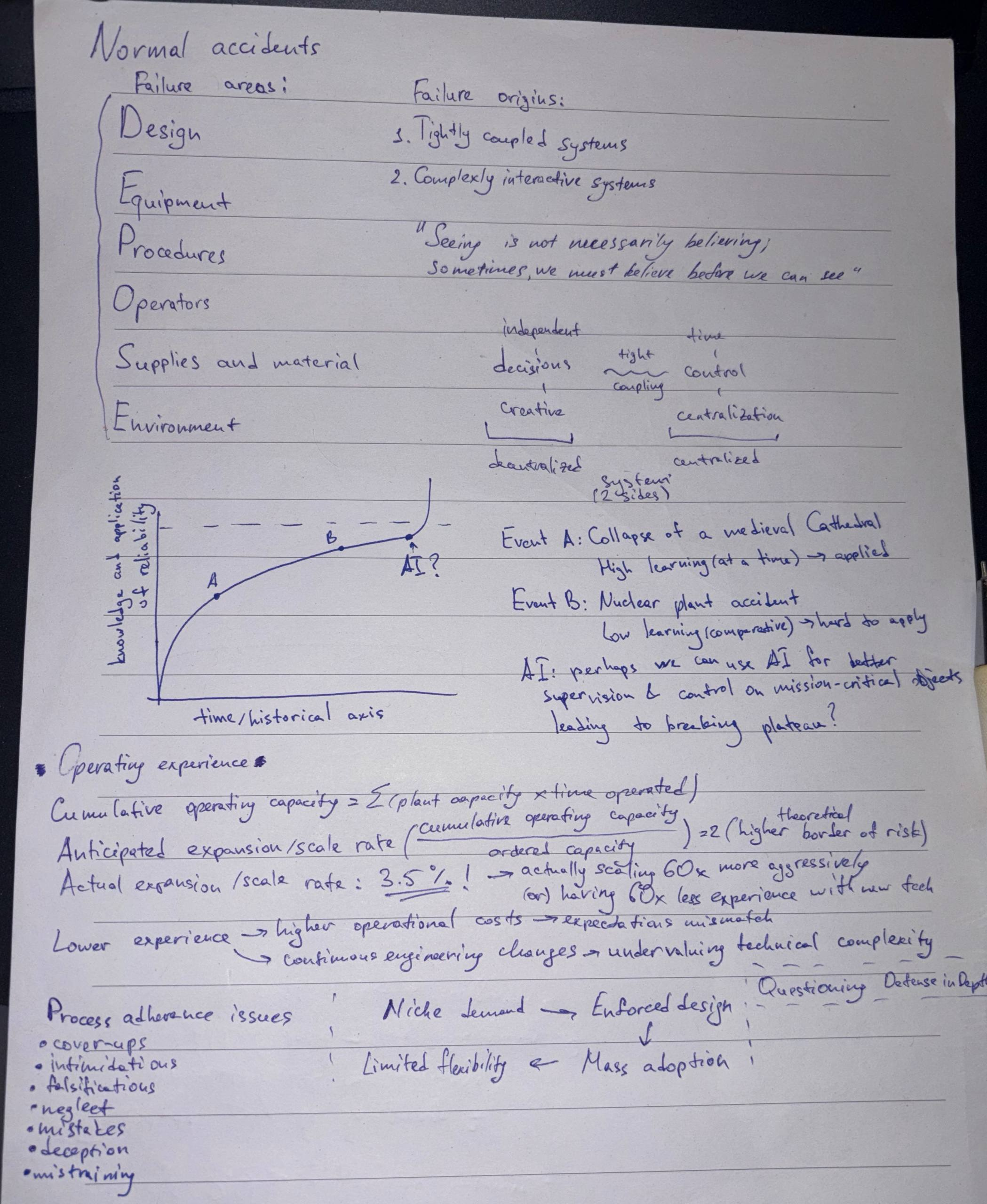
Failure areas:
- Design
- Equipment
- Procedures
- Operators
- Supplies and material
- Environment
Failure origins:
- Tightly coupled systems
- Complexly interactive systems
“Seeing is not necessarily believing;
Sometimes, we must believe before we can see”
System (2 sides)
independent decisions
Creative
↓
decentralized
tight coupling
time control
↓
centralized
Reliability Graph
- Event A: Collapse of a medieval Cathedral
High learning (at a time) → applied - Event B: Nuclear plant accident
Low learning (comparative) → hard to apply - AI: perhaps we can use AI for better supervision & control on mission-critical objects leading to breaking plateau?
Operating experience
Cumulative operating capacity = Σ (plant capacity × time operated)
Anticipated expansion / scale rate = 2 × (higher theoretical border of risk)
(Formula: cumulative operating capacity / ordered capacity)
(Formula: cumulative operating capacity / ordered capacity)
- Actual expansion / scale rate: 3.5%! → actually scaling 60x more aggressively (or) having 60x less experience with new tech
Lower experience
higher operational costs
→
expectations mismatch
continuous engineering changes
→
undervaluing technical complexity
Process adherence issues:
- cover-ups
- intimidations
- falsifications
- neglect
- mistakes
- deception
- mistraining
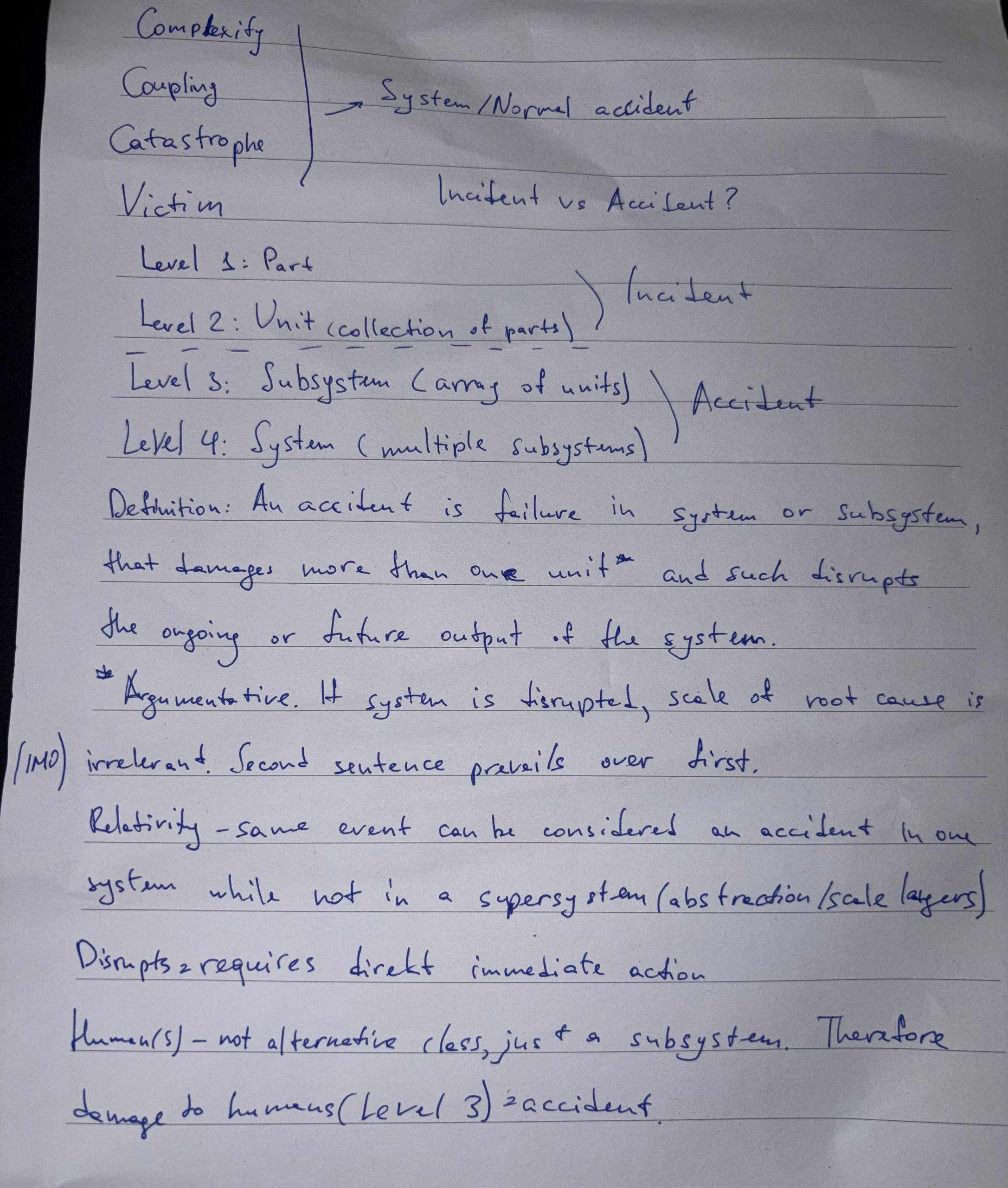
Defining Accidents & Incidents
Incident vs. Accident?
Incident
Level 1: Part
Level 2: Unit
(collection of parts)
Accident
Level 3: Subsystem
(array of units)
Level 4: System
(multiple subsystems)
- Definition: An accident is failure in system or subsystem, that damages more than one unit* and such disrupts the ongoing or future output of the system. * Argumentative. If system is disrupted, scale of root cause is (IMO) irrelevant. Second sentence prevails over first.
- Relativity: Same event can be considered an accident in one system while not in a supersystem (abstraction / scale layers).
- Disrupts: Requires direct immediate action.
- Human(s): Not alternative class, just a subsystem. Therefore damage to humans (Level 3) = accident.
Questioning Defense in Depth?
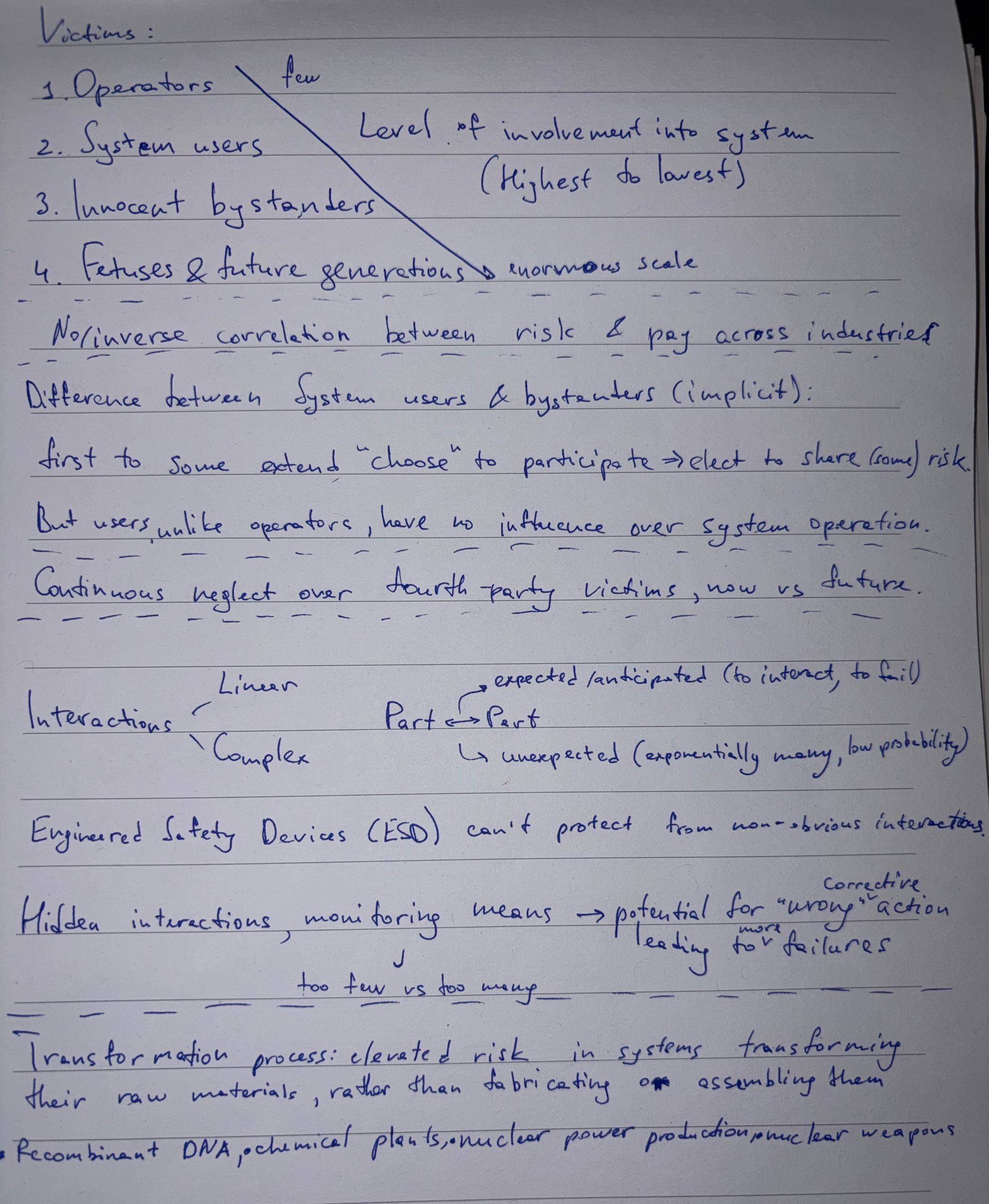
Victims:
1. Operators
few
2. System users
3. Innocent bystanders
4. Fetuses & future generations
enormous scale
Level of involvement into system (Highest to lowest)
- Risk and Pay: No/inverse correlation between risk & pay across industries.
- System Users vs. Bystanders (implicit): First to some extent “choose” to participate => elect to share (some) risk. But users, unlike operators, have no influence over system operation.
- Fourth-Party Victims: Continuous neglect over fourth party victims, now vs future.
Interactions: Linear / Complex
- Engineered Safety Devices (ESD): Can’t protect from non-obvious interactions.
- Monitoring & Corrective Actions: Hidden interactions, monitoring means (too few vs too many) => potential for “wrong” corrective action leading to more failures.
Transformation process:
elevated risk in systems transforming their raw materials, rather than fabricating or assembling them
Recombinant DNA
chemical plants
nuclear power production
nuclear weapons