HRO Theory - Notes
2026-05-22 – Transcribed notes on High Reliability Organization (HRO) Theory principles, signals, and organizational questions.
HRO - High Reliability Organization (Theory)
📖 View Original Handwritten Notes (English Source)
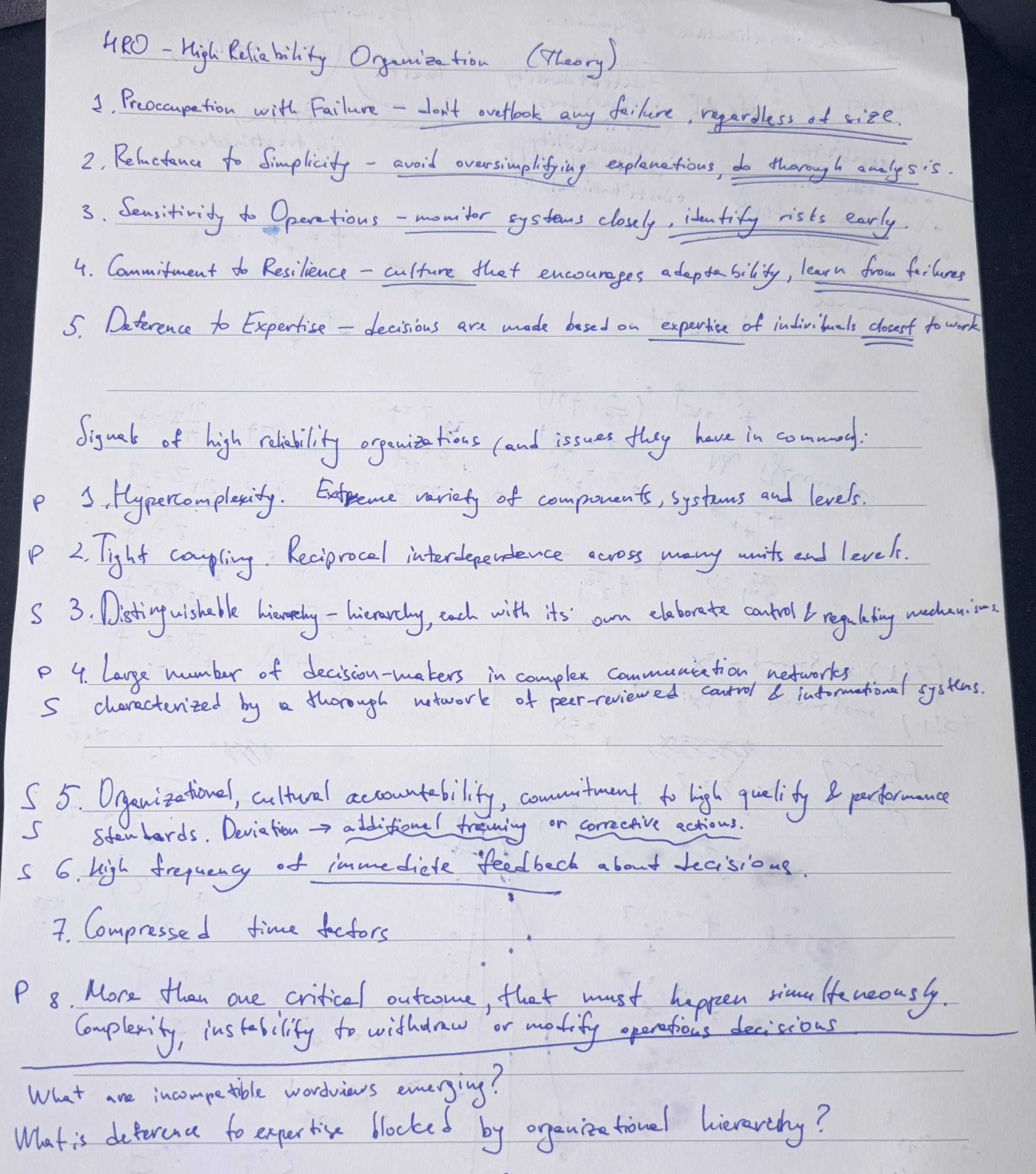
- Preoccupation with Failure – don’t overlook any failure, regardless of size.
- Reluctance to Simplicity – avoid oversimplifying explanations, do thorough analysis.
- Sensitivity to Operations – monitor systems closely, identify risks early.
- Commitment to Resilience – culture that encourages adaptability, learn from failures.
- Deference to Expertise – decisions are made based on expertise of individuals closest to work.
Signals of high reliability organizations (and issues they have in common):
- [P] 1. Hypercomplexity. Extreme variety of components, systems and levels.
- [P] 2. Tight coupling. Reciprocal interdependence across many units and levels.
- [S] 3. Distinguishable hierarchy – hierarchy, each with its own elaborate control & regulating mechanisms.
- [P / S] 4. Large number of decision-makers in complex communication networks characterized by a thorough network of peer-reviewed control & informational systems.
- [S / S] 5. Organizational, cultural accountability, commitment to high quality & performance standards. Deviation → additional training or corrective actions.
- [S] 6. High frequency of immediate feedback about decisions.
- 7. Compressed time factors
- [P] 8. More than one critical outcome, that must happen simultaneously. Complexity, inability to withdraw or modify operations decisions.
Critical Questions:
- What are incompatible worldviews emerging?
- What is deference to expertise blocked by organizational hierarchy?